IAC Framework- Easy Entry, Limitless Potential

The "Double Bubble" shows the interconnection between study of history and student action

How do I weave civic empowerment throughout my course? Let me count the ways…..

We hope you all had a rejuvenating and relaxing summer break.  September is Civic Awareness Month. Now, more than ever, teachers recognize the importance of nurturing a new generation of youth who can help shape the future. With the new year starting, you have a fresh opportunity to seamlessly build student agency and voice by incorporating the lenses of change-analysis and civic engagement into course content.  This issue of our newsletter explores the range of possibilities:
Interested in IACP? Join our Free Virtual Saturday Series! 
Learn More and Register Here

Options for building student agency in your classroom with IAC:

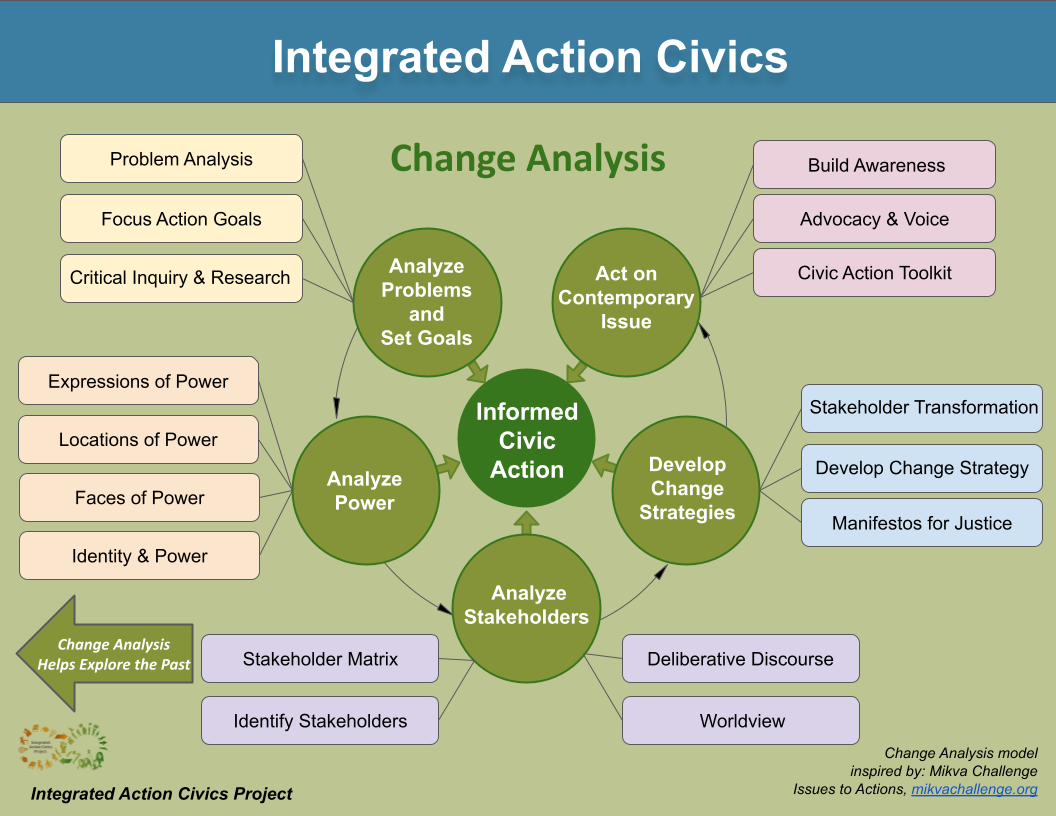
Diagram shows the sets of strategies associated with the different IAC lenses of change-making

Many teachers have the mistaken idea that the IAC framework has to involve a significant redesign of their course or teaching approach. While some teachers have made major shifts in order to deeply weave this framework throughout their curriculum, most just use a handful of strategies that they find helpful for their students. Teachers select and use particular IAC strategies for one or more learning goals:

  • Self-Exploration: These help students explore their values, worldview, and sense of justice. They also can serve to strengthen the sense of community in your classroom.

  • Conceptual: A few strategies are best suited to develop concepts about justice or introduce the language of power or other foundational ideas that can be referenced throughout a course.

  • Content Study: Most strategies are used to teach your normal content but through the unique and revealing lenses of power, stakeholders, root causes, etc.

  • Student Civic Engagement: Different sequences and numbers of strategies can be used to guide students as they respond to issues in their community.  Selected depending on time and learning goals, they can support projects ranging from just a poster or letter to multi-year, interdisciplinary campaigns.

Teacher's Perspective: Using IAC Strategies to Teach Curriculum.

The following is an interview with Holly Royaltey, a veteran teacher at McDonald High School in Santa Clara.  Holly has been using IAC strategies for years.  This interview has been edited for clarity and length. You can read the full transcript here.

DH: Thank you, Holly, for speaking with me today, You’ve spent years integrating Integrated Action Civics (IAC) strategies into your courses. What are your primary goals in doing this, and how has it shifted your overall approach to teaching?

HR: The main goal is for students to actually make use of the content they are learning, develop critical thinking skills, and transfer those tools outside of history class—to issues in their school, community, or personal lives. I’m much more of the mind now where I don’t feel the need to teach as much sheer content. Rather than trying to cover everything and just cross my fingers, the framework gives us the flexibility and space to focus on processing, analyzing, and thinking.

Strategically, these frameworks give students a schema. Whether we are using the Power Flower in AP Government to look at political socialization, the Cause-Consequence tree for the Industrial Revolution, or Envisioning Justice during a unit on wealth and poverty, the strategies give students a lens. When reading or taking notes, it gives them a clear purpose. Instead of just gathering basic facts, they are analyzing how policies line up with their own sense of justice or how power dynamics work. It makes the content stick—they pull from first-semester models clear into the second semester because it’s locked in conceptually.

DH: How do these strategies help build student voice, critical thinking, and civic agency, particularly across different student populations?

HR: It moves the onus of learning onto the students and gives them genuine control. So much is happening in the world right now, and students often lack the specific language to describe what they are experiencing beyond just saying, "I don't like this." These strategies give them the vocabulary to name power imbalances and analyze complex systems. A simple model like the Cause-Consequence tree can be used even to break down personal challenges like procrastination, and then applied to massive issues like local homelessness or mass incarceration in US history. It shows students that outcomes aren't inevitable and that there are multiple leverage points for change.

In terms of demographics, it impacts students in different, powerful ways. In high-achieving, affluent settings, students can initially feel frustrated because the strategies require them to slow down and analyze rather than quickly hunt for the "right answer." In settings with more English learners, special education students, or socioeconomically disadvantaged youth, having structured frameworks builds confidence. Once you give them the language and repeat these frameworks across units, their conversations become dramatically richer. They realize that they are empowering themselves right now through the act of analyzing and researching.

DH: Many teachers worry about the time commitment required to rethink their curriculum. How simple is it to adapt existing lessons to incorporate these frameworks?

HR: You definitely do not need to reinvent the wheel. It is usually just a matter of keeping your existing content and primary sources, but shifting what students do with that information. Instead of having students read an article and simply summarize it at the end—which is how I might have approached it previously—you use a strategy as an active lens. You have them mark the text for causes, consequences, or expressions of power, and then use a graphic organizer like the tree to process that reading.

When it comes to modifying IAC templates, I almost never change the graphic templates themselves—the tree is the tree, and the Locations of Power organizer works well. I just modify the prompt. Applying a power analysis prompt to student research on the founding of the United States. looks very different from applying it to 1980s welfare cuts, but the underlying tool remains the same. That makes scaffolding extremely simple for the teacher and predictable for the students.

DH: What advice would you give to a teacher who is curious or hesitant about trying these strategies for the first time?

HR: The easiest way to start is to pick one strategy tied to something you already teach frequently, like cause and consequence. Take a reading you already use, have students mark the text for causes and consequences, print out a Cause-Consequence tree, and let them tackle it as a basic processing activity. That's it—it really is that simple.

Once you and your students feel comfortable with that first tool, you can start building in others, like Expressions of Power or Worldview. The Sense-of-Self strategies are especially easy to use as they are because they can be used with minimum modification, are naturally student-centered, and create instant buy-in. Integrating IAC has completely transformed my teaching practice. I would much rather spend valuable classroom time teaching students how to analyze, think critically, and take apart complex issues than sacrifice that depth just to cover more content.